
When people search for what to expect from The Odyssey (2026), the real question is simple. What kind of movie is this actually going to feel like?
Christopher Nolan directing a Greek epic sounds big on paper. The film releases on July 17, 2026, and the cast alone, Matt Damon, Tom Holland, Anne Hathaway, Robert Pattinson, Lupita Nyong’o, along with Zendaya and Charlize Theron, signals scale. But Nolan’s films rarely behave like traditional blockbusters. That is where expectations need adjusting.
This likely won’t play like Troy or even Gladiator in a straightforward sense. Those films lean into clear emotional arcs and direct storytelling. Nolan usually resists that. Even when he works with large-scale material like Dunkirk or Interstellar, the structure tends to be fragmented, sometimes non-linear. That approach changes how a story like The Odyssey might unfold.
The source material itself is episodic. Odysseus moving from one trial to another, islands, creatures, gods interfering. Most adaptations simplify this into a clean journey. Nolan probably won’t. There is a strong chance the narrative will feel segmented, possibly jumping between timelines or perspectives. That is familiar territory for him, but it also means the film may demand more attention than a typical mythological epic.
At the same time, this is not science fiction. There is no high-concept scientific hook like Tenet or Inception. The scale will come from physical environments and production design. Shot using new IMAX film technology, the emphasis will likely be on realism, large landscapes, practical effects. Visually, this could sit closer to Dune in terms of scale, but without the same world-building exposition.
Tone is another thing to we should look at. Marketing calls it a “mythic action epic,” but Nolan does not usually lean into spectacle for its own sake. Action sequences may be present, but they tend to feel controlled rather than explosive. If you are expecting constant battles or large-scale war sequences like Gladiator, that might not be the focus. The tension in Nolan’s films often comes from structure and pacing, not just action.
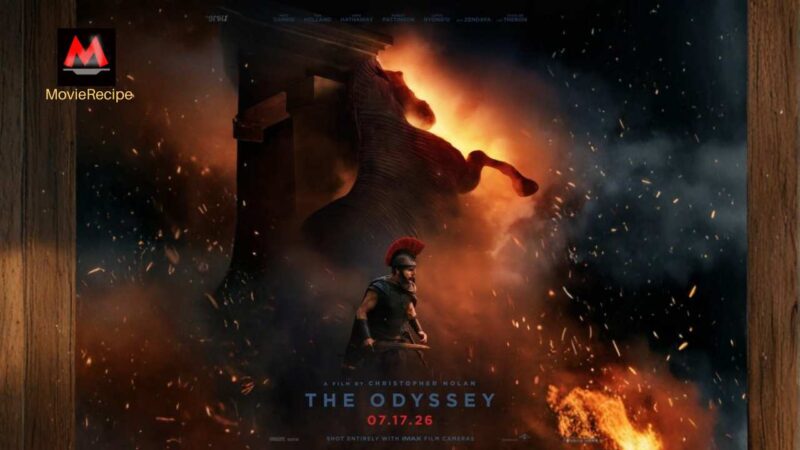
The cast is stacked, but that does not automatically mean character-driven storytelling in the traditional sense. Nolan often uses actors as parts of a larger design. Matt Damon could be the emotional anchor, but even then, his arc may feel restrained rather than openly expressive. That has been a consistent pattern across Nolan’s work.
Where the film probably stands among mythological epic movies is somewhere between The Northman and Dune. Not as raw and intimate as The Northman, not as lore-heavy as Dune, but still serious in tone. It is unlikely to have the operatic emotional highs of older epics. Instead, it may feel more observational, even slightly distant at times.
That could divide audiences. Viewers expecting a traditional retelling of Homer’s story might find it colder or more structured than expected. But for those used to Nolan’s style, this is where it works. The material gives him scale without relying on science fiction.
So in simple terms, what to expect from The Odyssey (2026) comes down to this. A large, visually controlled epic that focuses more on structure and atmosphere than emotional spectacle. It will probably sit closer to Nolan’s previous work than to classic Greek adaptations, even if the setting suggests otherwise.