
Netflix’s Nothing to Lose opens with a familiar but emotionally effective setup. Jada, played by Nawell Madani, spends years trying to become a mother before finally welcoming her son, Noa. What follows isn’t simply another story about childhood illness. It’s about what happens when hope begins to disappear and every option seems to arrive too late.
Released on July 8, 2026 on Netflix, the French drama, co-directed by Nawell Madani and Ludovic Colbeau-Justin, follows Jada as she searches for a compatible bone marrow donor after Noa is diagnosed with a rare and aggressive form of leukemia. Guillaume Gouix plays her estranged husband Paul, while Paul Fouré delivers a quietly affecting performance as Noa.
Nothing to Lose Review
The emotional premise is easy to connect with because it taps into one universal fear. Every parent wants to believe that determination can solve any problem. Nothing to Lose asks what happens when determination isn’t enough.
The early scenes spend time establishing Jada’s struggle to become a mother and the sacrifices that gradually reshape her life. Some of you may find this opening slower than expected, but it makes the bond between mother and son real before the crisis begins. Without that foundation, many later moments would carry far less emotional impact.
The drama movie also deserves credit for bringing attention to bone marrow donation without turning every scene into a lecture. It quietly reminds viewers that finding a compatible donor is far more complicated than many people realize, especially for patients from underrepresented backgrounds. Instead of creating a traditional villain, the story presents a system that simply cannot move quickly enough when time is running out.
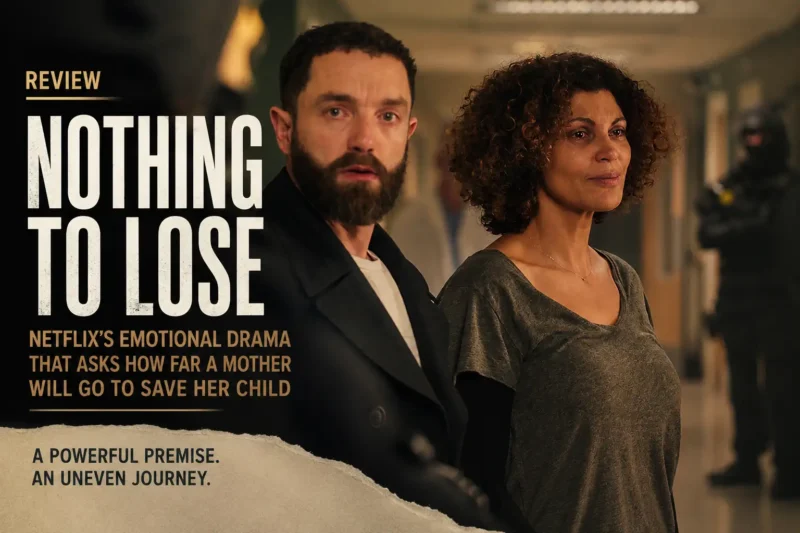
Nawell Madani carries almost every scene, and it’s easily her most demanding performance to date. Best known for comedy and lighter roles, she plays Jada with relentless intensity. The performance makes an impact because she never portrays Jada as fearless. She’s exhausted, angry, desperate, and increasingly consumed by the possibility of losing the one thing she fought hardest to have.
But the film changes considerably in its second half. Without revealing major plot details, the story transforms from an intimate family drama into something much closer to a thriller. It’s an ambitious decision that gives the narrative urgency, but it also asks the audience to accept increasingly dramatic choices that may divide viewers.
Some will see those choices as a believable extension of overwhelming parental desperation. Others may struggle with how quickly the story moves away from realism. The film isn’t really asking whether Jada is making the right decisions. Instead, it asks whether love can push someone beyond the boundaries they once believed they would never cross.
That idea is compelling. However, the execution may seem uneven at times. The screenplay occasionally leans too heavily on emotional shortcuts instead of allowing difficult situations to speak for themselves. Several conflicts resolve more conveniently than expected, reducing some of the moral complexity the premise naturally creates. Moments that should leave viewers questioning Jada’s actions sometimes encourage sympathy without fully exploring the consequences.
Even so, Nothing to Lose remains engaging because it never loses sight of what drives its central character. Every difficult decision grows from the same fear: running out of time.
The supporting cast contributes without overshadowing Madani. Guillaume Gouix brings enough emotional restraint to make Paul’s relationship with Jada believable, even if parts of their storyline could have benefited from greater development. Nicolas Briançon also gives the medical side of the story a welcome sense of humanity, portraying a doctor caught between compassion and the limits of what the system can realistically provide.
Visually, Nothing to Lose avoids unnecessary spectacle. The direction keeps the focus on faces, conversations, and the growing pressure surrounding Jada. That grounded presentation makes the later escalation feel even more dramatic, whether viewers embrace it or not.
The film raises awareness without becoming entirely issue-driven. The discussion around donor registries and pediatric cancer exists because it’s woven into the characters’ lives rather than presented as statistics. Even viewers who disagree with some of the storytelling choices will probably leave with a better understanding of why donor registration matters.
If you’re expecting something like My Sister’s Keeper, you’ll find similar emotional territory, though Nothing to Lose becomes more suspense-driven as it progresses. It also shares some DNA with John Q, where a parent’s desperation eventually collides with institutional limits. The difference is that this film spends more time exploring emotional exhaustion than delivering crowd-pleasing heroics.
Nothing to Lose doesn’t completely succeed at balancing its intimate drama with its larger thriller ambitions. There are moments when the screenplay reaches for emotional impact instead of earning it, and the tonal shift won’t work for everyone. But beneath those flaws is a sincere story about grief, hope, and the impossible decisions parents imagine they would never have to make.