
Netflix’s Human Vapor ending can surprise many. The series begins like a supernatural crime thriller but gradually becomes something more personal. The mystery revolves around impossible murders, a man who can turn into gas, and a government experiment that should never have existed. By the final episode, however, the biggest questions are not about Ren’s powers but about the choices he makes after discovering how those powers came to be.
The eight-episode series, released on July 2, 2026, stars Shun Oguri as Ren alongside Yu Aoi, Suzu Hirose, Kento Hayashi, and Yutaka Takenouchi. Although it draws inspiration from Toho’s 1960 cult classic The Human Vapor, this version tells an entirely new story that mixes conspiracy, detective drama, and science fiction.
For most of the series, investigators believe they’re chasing a serial killer who somehow slips through walls and disappears into thin air. Every clue points toward Ren, but the deeper the investigation goes, the clearer it becomes that he is also a victim. His strange abilities are linked to a secret project that experimented on vulnerable people and erased anyone connected to it. The explosions and public killings are meant to expose that hidden truth, even if Ren’s methods make him look like the villain.
Human Vapor Ending Explained
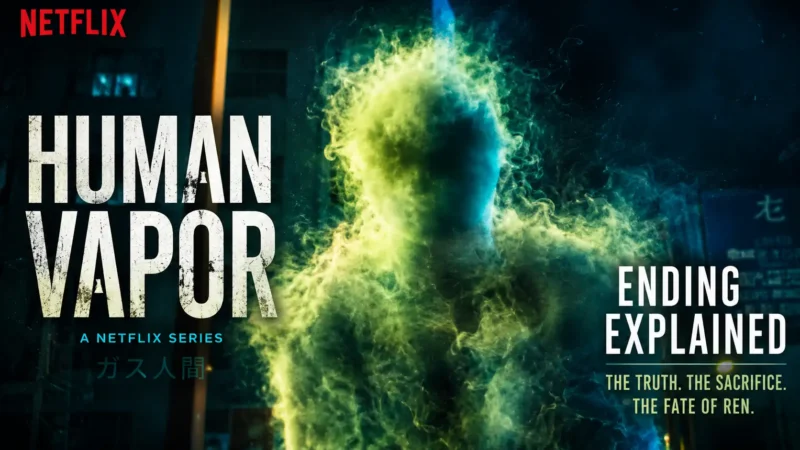
The final episode changes the emotional focus. Ren finally reaches Kyoko after everything they have survived together. Instead of ending with another confrontation, the story suddenly changes flavor. Human Vapor becomes about whether someone whose body is literally disappearing can still have a normal future. Ren realizes that his transformation is irreversible. Every use of his power pulls him further away from being human, leaving him with no real escape.
The ending is deliberately made bittersweet. Ren and Kyoko disappear together as his body dissolves completely, leaving Detective Kenji to witness the moment without being able to stop it. Rather than presenting a conventional victory over the conspiracy, the series suggests that exposing the truth comes at an irreversible personal cost. And the cost is, Ren cannot return to ordinary life after becoming the Human Vapor.
That final scene also gives the title a different meaning. Throughout the series, vapor represents more than a supernatural ability. It symbolizes people who are treated as disposable by powerful institutions. The secret project turned human beings into experiments, and Ren’s fading body becomes a reminder that the damage cannot be undone. But if you look closely, his disappearance is less about death and more about losing the identity that once made him human.
This is where Human Vapor ending separates itself from traditional sci-fi thrillers. It has action and mystery, but its ending is surprisingly restrained. Instead of delivering a massive twist in the final minutes, it focuses on sacrifice and regret. Fans expecting an explosive showdown may find the finale quieter than expected.
The Human Vapor ending also echoes the tragic tone of Toho’s 1960 film, where extraordinary powers ultimately become a curse rather than a gift. Both stories treat the protagonist less as a superhero and more as someone destroyed by circumstances beyond his control. However, the Netflix adaptation creates an entirely new conspiracy-driven narrative around that idea.
Whether Netflix continues the story remains unclear. The series was developed as a limited eight-episode event, and the ending provides emotional closure even though some questions about the government project remain unanswered. Those loose threads could support another season, but the final moments feel complete enough to stand on their own.
What to Watch After Human Vapor
Parasyte: The Grey (2024) – Humans become hosts for alien parasites, creating a tense mix of horror, action, and moral conflict.
Hellbound (2021) – A supernatural mystery about unexplained deaths, public fear, and dangerous belief systems from the same creator, Yeon Sang-ho.
Alice in Borderland (2020) – Ordinary people are forced into deadly games while trying to uncover the truth behind their reality.
Gannibal (2022) – A slow-burn Japanese thriller where an isolated village hides disturbing secrets.
Dark (2017) – A layered mystery that combines science fiction with emotional family drama and rewarding twists.