
The easiest way to explain The Boroughs is probably “Stranger Things for retirees.” And honestly, Netflix knows people are going to say that the second they see the trailer. A strange creature appears. A quiet community hides something dangerous. A group of outsiders starts digging into secrets nobody else wants to acknowledge.
But the more interesting comparison might actually be with The Thursday Murder Club.
What makes The Boroughs stand out is not just the mysterious monster. It is also that the people fighting it are old enough to be ignored by almost everyone around them.
What is The Boroughs About?
Set in a retirement community in the New Mexico desert, the series follows Sam Cooper, played by Alfred Molina, who arrives at The Boroughs carrying grief and isolation with him. The place is designed to look peaceful. Sunlit streets, carefully managed routines, neighbors trying to enjoy what is supposed to be the easy part of life. Then the horror element arrives. Sam witnesses something terrifying at night and immediately gets dismissed as another confused old man.
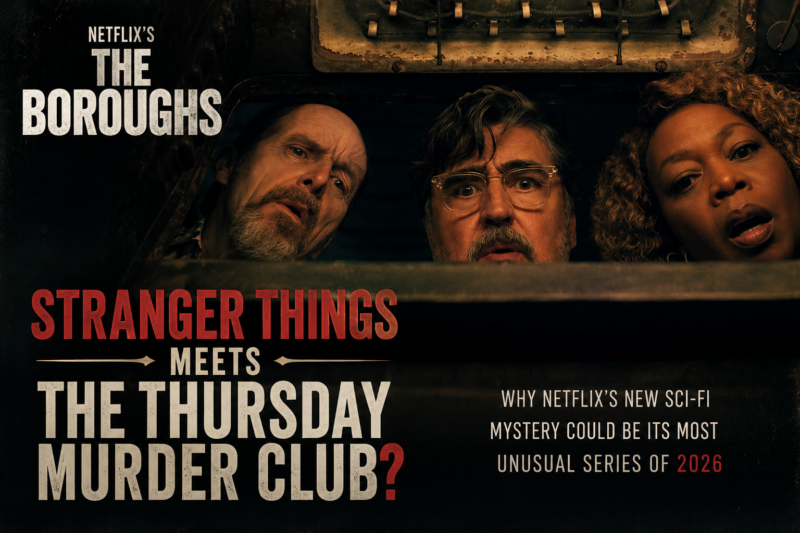
That scenario works because it taps into something real very quickly. Aging in genre fiction is usually treated as background texture. Older characters become mentors, comic relief, or emotional support for younger leads. The Boroughs, like The Thursday Murder Club and Inside Man puts the older characters into action while the systems around them refuse to take them seriously.
The Cast
Alfred Molina already brings a tired, grounded quality that fits the premise perfectly. Geena Davis, Alfre Woodard, Denis O’Hare, Clarke Peters, and Bill Pullman do not feel like stunt casting either. The group has the kind of presence that instantly makes the show feel slower, more observational, and probably more emotional than most Netflix sci-fi series.
That is where the Thursday Murder Club comparison starts making sense. Not because the stories are similar, but because both projects rely on older characters solving problems people assume they cannot handle anymore. There is also something inherently enjoyable about watching experienced actors bounce off each other in ensemble mysteries. Younger casts often bring energy. Older casts bring rhythm.
Still, The Boroughs looks far darker than Richard Osman’s mystery world. The trailer leans heavily into paranoia, memory, and time running out. Netflix keeps emphasizing the idea that these residents are fighting for the one thing they no longer have enough of. That pushes the series closer to existential horror than cozy mystery.
The sci-fi angle also looks more creature-driven than psychological, at least initially. Something is physically stalking the community. But the premise probably works better if the horror becomes symbolic over time. The fear of becoming invisible, forgotten, or dismissed feels baked into the concept already.
There is also an interesting risk here.
Streaming platforms love the “small community hiding dark secrets” formula because Stranger Things turned it into one of Netflix’s defining brands. But audiences have started recognizing the structure immediately. Secretive authority figures. Strange disappearances. Unlikely investigators. Creepy nighttime scenes. If The Boroughs only repeats those beats with older characters, the novelty could wear off quickly.
The good news is the setting itself changes the emotional stakes. Teenage characters in supernatural stories usually represent potential and discovery. Retired characters carry regret, memory, health concerns, and the awareness that time is limited. This gives the horror a different color when the people involved are already confronting mortality before the monster even appears.
The Boroughs is scheduled to release in the United States on May 21, 2026, and it already feels positioned as one of Netflix’s bigger genre launches for the year. The Duffer Brothers connection guarantees comparisons to Stranger Things, whether the show wants them or not. But The Boroughs might work best when it stops reminding viewers of other Netflix mysteries and leans fully into its own aging-and-survival angle.
Because there are plenty of sci-fi shows about young people discovering danger for the first time. There are not many about older people realizing nobody is coming to help them anymore.