
When Heart of the Beast trailer arrived, most people focused on the obvious selling points. Brad Pitt is stranded in the Alaskan wilderness. His only companion is Odin, a combat dog he served alongside in the military. There is a plane crash, harsh weather, dangerous terrain, and a fight to stay alive.
But the title keeps drawing attention for another reason. The trailer calls attention to it directly when a local character tells James Belmont, “This region here is the heart of the beast. Most folks learn that the hard way.”
The line feels less like a geographical description and more like the key to understanding what the movie is really about.
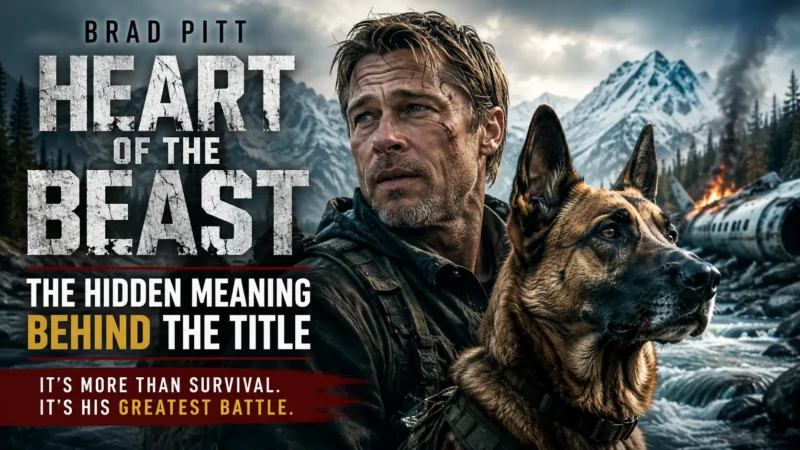
Directed by David Ayer and arriving on September 25, 2026, Heart of the Beast stars Brad Pitt as retired Special Forces officer James Belmont, alongside J.K. Simmons and Anna Lambe. On the surface, the story looks straightforward. After a devastating plane crash, James and Odin must survive in one of the most unforgiving environments on Earth.
But there is also something deeper at work here. The most obvious interpretation is that the “beast” refers to Alaska itself. The wilderness shown in the footage is not presented as a beautiful backdrop. It feels hostile and unpredictable. Rivers become obstacles. Mountains become barriers. The weather looks capable of killing both man and animal at any moment.
Movies like The Grey and The Revenant used nature in a similar way. The environment was not simply where the story happened. It became an active force pushing the characters to their limits.
That may be exactly what David Ayer is trying here. But it is the second layer that seems even more important. James Belmont does not appear to be a man who left war behind.
Early in the Heart of the Beast trailer we see flashes of combat, explosions, and battlefield memories. One moment shows him waking from what appears to be a nightmare. Another conversation reveals Odin’s injuries came from military service, including a violent encounter that left the dog with silver teeth.
When someone jokes about the man responsible, James calmly responds that he shot him in the head. The line gets a laugh in the scene, but it also tells us something about the character. This is a man carrying experiences that most people cannot relate to.
That is where the title starts to take on a different meaning. The beast may not be the wilderness. The beast may be everything James brought with him into it.
Many survival stories work because the external struggle mirrors an internal one. The character is fighting the environment, but they are also fighting guilt, grief, fear, trauma, or regret.
The trailer repeatedly returns to the bond between James and Odin. Their relationship feels less like owner and pet and more like two veterans trying to make it through one last mission together. When James says, “We’ve been through worse,” it sounds as if he is talking about more than the crash.
It feels like a reference to their shared past. That idea becomes even stronger later when he says, “One last mission. We’re not gonna die out here.”
Military language keeps appearing throughout the trailer. Survival is framed almost like a combat operation. James is not simply trying to get home. He is falling back into the mindset that once kept him alive. The problem is that mindset may also be the thing he has never escaped. This is where the title becomes interesting.
The Heart of the Beast could represent the point where a person is forced to confront what they fear most. Not a bear. Not a storm. Not starvation.
Themselves.
David Ayer’s best films often focus on people pushed into extreme situations. End of Watch explored loyalty under pressure. Fury examined how war changes people over time. Those stories were never only about action. They were about what happens to individuals when they are forced to keep going after reaching their limits.
Heart of the Beast appears to be operating in that same space.
The dog too also plays a significant symbolic role. Odin is physically scarred, missing part of his mobility, and carrying injuries from combat. Yet he keeps moving forward. The trailer repeatedly emphasizes his determination rather than his limitations.
The line, “It’s not the size of the dog in the fight that matters. It’s the size of the fight in the dog,” is not just about Odin. It is about James as well.
Both characters are wounded. Both are survivors. Both seem to be carrying scars that never fully healed. That may be why the emotional center of the movie feels stronger than the survival premise itself.
The wilderness is the challenge. The bond between James and Odin is the story. And the beast may be everything standing between them and finding peace.
If that interpretation proves accurate, Heart of the Beast could end up being much more than a man-versus-nature thriller. It could be a film about resilience, recovery, and the struggle to move beyond the worst experiences of your life.
The trailer certainly leaves room for action and suspense. There are dangerous river crossings, injuries, isolation, and moments where survival appears impossible. But the title suggests the real battle is happening somewhere else.
Deep inside a man who thought his wars were already over.