
When Girls Like Girls arrives in theaters on June 19, 2026, a lot of people will see it as a movie adaptation of Hayley Kiyoko’s bestselling novel. Technically that’s true. But that description misses the most interesting part of the story.
The film actually started more than a decade ago as a four-minute music video that quietly became one of the most influential queer pop culture moments of the 2010s. What makes the movie unusual is not the romance between Coley and Sonya. It’s the fact that Hollywood rarely gives stories like this ten years to evolve.
Most viral hits disappear within months. Even successful novels often struggle to make it to the screen. Girls Like Girls somehow survived multiple cultural eras, several formats, and years of development before becoming a Focus Features release.
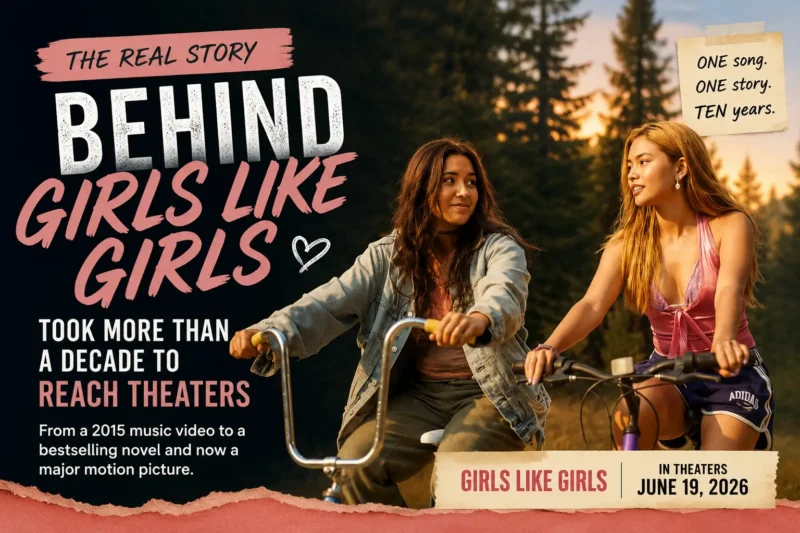
The journey started in 2015 when Hayley Kiyoko released the song “Girls Like Girls” on her EP This Side of Paradise. Alongside the track came a music video that followed two teenage girls navigating attraction, friendship, and the confusion that comes with first love. At the time, queer female relationships were still rarely portrayed as the central focus of mainstream music videos.
Over the years, the video accumulated more than 160 million YouTube views and developed something more valuable than viral success. It became a touchstone for an audience that saw pieces of their own experiences reflected in Coley and Sonya.
That’s where most stories would have ended. Instead, Kiyoko kept returning to the same characters.
In 2023, she expanded the story into a novel that debuted as a New York Times bestseller. But even then, the book wasn’t the final destination. It was another step toward a goal Kiyoko had been pursuing for years. According to confidantes, she spent much of the past decade creating pitches and presentations in an effort to convince people that the story deserved a feature film.
That persistence may explain why Girls Like Girls feels different from many modern adaptations. Most adaptations begin with a successful property and then move quickly toward production. This one evolved slowly.
Then video.
Then novel.
Now film.
What also makes the project unusual is that Kiyoko didn’t simply hand the story over to another filmmaker. She directed the film herself. For a first-time feature director, that’s a significant responsibility. But it also gives the adaptation a level of continuity that’s rare. The same person who wrote the song, inspired the original story, and expanded it into a novel is now directing the movie version.
Sources repeatedly describe Coley’s experiences as being heavily inspired by Kiyoko’s own memories of first love, heartbreak, and self-discovery. The Girls Like Girls film is not simply adapting fictional characters. In many ways, it’s revisiting a younger version of herself.
Maya da Costa plays Coley, while Myra Molloy takes on the role of Sonya. Zach Braff appears as Coley’s father Curtis, bringing some recognizable star power to a cast largely built around younger performers. The story unfolds during the summer of 2006 in a small Oregon town, where Coley develops feelings for the charismatic Sonya while navigating family tensions and questions about her own identity.
But what may surprise audiences is that Girls Like Girls is not trying to function as a nostalgic recreation of the music video.
Kiyoko has openly discussed changing elements of the story and reshaping its ending. One of the biggest adjustments is that the film moves attention away from the male love-triangle dynamic that helped drive conflict in the original video. Instead, the focus stays firmly on the relationship between Coley and Sonya.
That choice says a lot about how both the story and the culture around it have changed since 2015. Back then, simply portraying a queer teenage romance so openly felt significant.
In 2026, the challenge is different. Audiences expect more than representation alone. They want layered characters, emotional specificity, and stories that can stand on their own regardless of identity labels.
That may be why the film’s strongest selling point isn’t that it’s a queer romance. It’s that it appears to be a very specific story about first love.
It consumes your thoughts and makes every text message feel important. That emotional core is probably why Girls Like Girls survived long enough to become a movie in the first place.
What to Watch After Girls Like Girls
The Half of It (2020)
A shy student helps a popular athlete write love letters while developing feelings of her own.
Crush (2022)
A high school artist joins the track team and unexpectedly falls for someone she never expected.
Love, Simon (2018)
A teenager struggles to reveal a secret while searching for the anonymous classmate he’s fallen for.
Heartstopper (2022–Present)
A gentle coming-of-age series about friendship, identity, and first love.
Booksmart (2019)
Two best friends attempt to make up for years of missed teenage experiences in one chaotic night.
Lady Bird (2017)
A coming-of-age story that captures the awkwardness and intensity of late adolescence.
The Perks of Being a Wallflower (2012)
A deeply personal look at friendship, trauma, and finding where you belong.