
The most noticeable thing about Kentucky Roses is not the romance. It’s the structure. The film leans heavily on a dual timeline, moving between present day and the 1930s, and that choice ends up shaping everything else.
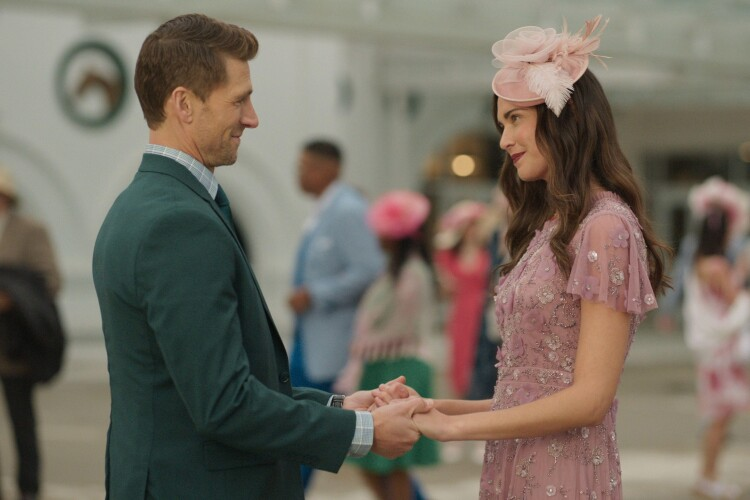
Set against Churchill Downs and premiering on May 2, 2026, the Hallmark film pairs Andrew Walker as Ash Taylor with Odette Annable’s Sadie Moore. On the surface, it follows a familiar setup. A strained family connection, a professional obligation pulling someone back home, and a romance that builds while problems need solving. But the film keeps cutting away from that to revisit a past love story tied to a missing necklace and a relationship that never worked out.
The 1930s storyline is positioned as emotional weight. A love story that failed because of class differences, now resurfacing through an heirloom that connects both leads. The intention is clear. The past is meant to raise the stakes of the present. It suggests that Ash and Sadie are not just falling in love, they are correcting something that went wrong decades ago.
Early on, the dual timeline feels intriguing. The transitions create a sense of mystery around the necklace and the history behind it. There is a slight “Titanic-like” framing, where an object becomes the bridge between timelines. It works for a while because it gives the film something more than just a straightforward romance.
However, as the story moves forward, the structure starts to compete with itself.
The present-day storyline already has enough going on. Ash is dealing with a complicated relationship with his father, who runs Churchill Downs. Sadie is trying to step out of her family’s shadow as a florist and prove herself, especially with the pressure of creating the iconic rose garland for the Kentucky Derby. There are practical stakes here. Deadlines, expectations, and personal history.
And then the Kentucky Roses keeps pulling away from that. Each return to the 1930s adds context, but it also slows the momentum of the present-day relationship. Instead of building steadily, the romance between Ash and Sadie sometimes feels interrupted. You don’t fully sit with their emotional progression before the film shifts back in time again.
This is where the dual timeline becomes less of a strength and more of a balancing issue.
At the same time, the past storyline carries a different tone. It is more restrained, more tragic, and in some ways more emotionally direct. The class divide feels sharper. The consequences feel permanent. That contrast is intentional, but it creates an odd effect. The past romance often feels more urgent than the present one, even though the film is clearly asking you to invest in both.
Because the film has to serve two timelines, neither gets complete breathing room. The 1930s story is condensed into key moments, while the present-day arc has to move faster than it probably should. You can feel that in how quickly certain emotional beats land, especially in the second half.
But the structure is not without payoff. As the connections between the timelines become clearer, the film does manage to tie its ideas together. The necklace, the unfinished love story, and the idea of choosing differently all come into focus. It leans into the idea that history does not repeat itself if people are willing to act differently. That is a simple idea, but it fits the tone Hallmark is aiming for.
That said, the 1930s sequences gives Kentucky Roses movie a different texture. The Churchill Downs setting gives Kentucky Roses a slightly larger scale than typical Hallmark movies. That contrast between eras adds visual variety even when the narrative balance feels uneven.
Is Kentucky Roses Worth Watching?
In the end, the dual timeline in Kentucky Roses on Hallmark Channel is doing more work than the romance itself. It adds ambition, but it also creates friction. The film is at its best when both timelines echo each other emotionally. It struggles when they start competing for attention.
The idea of connecting two love stories across time makes sense for a film built around legacy, tradition, and something as symbolic as the Kentucky Derby. But the structure asks for precision. And here, it occasionally feels like the film is trying to do more than it has time to fully support.
Still, it is one of the more interesting storytelling choices Hallmark has made recently. Even when it doesn’t fully land, it at least gives Kentucky Roses something to stand out.