
The HOT SPOT movie arrives with the familiar ingredients of modern science fiction. There is artificial intelligence, a near-future society, a murder investigation, and a world that looks like it is slowly falling apart. But after spending time with the film, it will become clear that the director Agnieszka Smoczyńska is interested in something else entirely.
The technology is important. The mystery is important. But neither feels like the real subject. The real question running through HOT SPOT is much simpler.
What does it mean to be connected to other people?
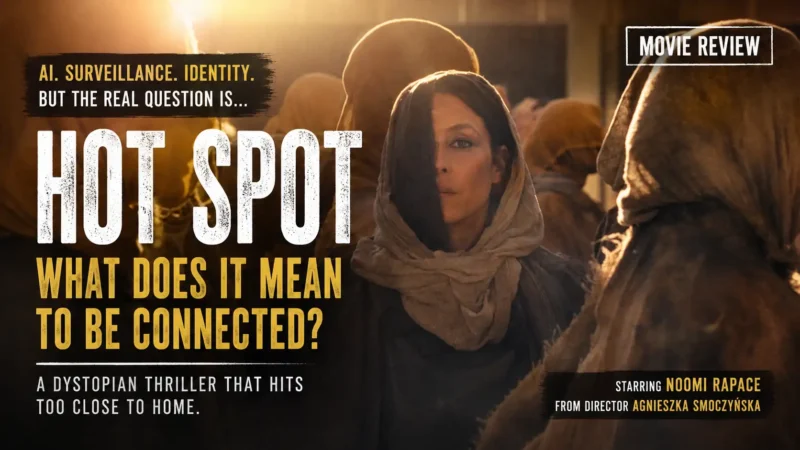
Set in a future where society depends on an AI system known as the Head, the film follows detective Djonny, played by Andrzej Konopka, as he investigates a murder linked to a group of refugees living outside the system’s control. At the center of that group is Rana, played by Noomi Rapace, a mysterious figure who challenges everything Djonny thinks he understands about reality.
That bit sounds like the beginning of a traditional dystopian thriller. But HOT SPOT keeps moving in stranger directions.
The Head is not presented as an obvious villain. It does not rule through fear in the way audiences might expect from classic AI dystopian movies. Instead, it offers convenience. It offers safety. It offers constant communication. Life is easier with it. That is what makes the film uncomfortable.
The citizens of this world are not forced into submission. They willingly accept a system that speaks into their minds, organizes their lives, and shapes their perception of reality. The trade-off feels familiar because it resembles conversations people are already having about technology, social media, algorithms, and AI.
The film’s strongest idea emerges through Djonny’s gradual breakdown. As he becomes connected to Rana, the certainty provided by the Head begins to disappear. His reality becomes unstable. Strange visions appear. His understanding of himself starts to fracture. At first this looks like a descent into madness. But HOT SPOT keeps suggesting another possibility.
Maybe Djonny is not losing himself. Maybe he is hearing himself for the first time. The movie repeatedly returns to the idea that modern people often mistake constant communication for genuine connection. The Head allows everyone to remain linked at all times. Yet many characters appear isolated, disconnected, and emotionally distant despite that endless flow of information.
One of the film’s most interesting details comes through Djonny’s son Zen. Despite growing up inside a system that keeps everyone connected, he longs for solitude. He misses the idea of being alone with his own thoughts. It is a small moment, but it may be one of the most revealing in the film.
Science fiction often imagines technology becoming more powerful. HOT SPOT imagines people becoming less capable of existing without it.
Here the film separates itself from many recent AI dystopian movies. Films such as The Creator or I, Robot focus on whether artificial intelligence becomes dangerous. HOT SPOT seems more interested in what happens when dependence becomes normal. The problem is not necessarily that the machines take over.
The problem may be that people stop trusting themselves.
Noomi Rapace’s Rana becomes the embodiment of that conflict. Djonny initially views her almost like a witch, someone capable of manipulating reality itself. But the film gradually suggests that Rana’s power may simply come from existing outside the digital system. She represents a person who still possesses an inner voice untouched by constant technological influence.
That idea gives the movie a surprisingly emotional core. For all its dystopian imagery, HOT SPOT is not really about technology. It is about intimacy. It is about identity, and the growing difficulty of understanding where our own thoughts end and outside influences begin.
The visual design supports that theme. Rather than creating a shiny future full of advanced gadgets, the filmmakers imagine a worn-out world shaped by drought, instability, and decay. The future looks old. Cities feel exhausted. Technology exists everywhere, but it has not solved humanity’s deeper problems.
That atmosphere gives the film a texture closer to Brazil, Dark City, or even Blade Runner 2049 than many contemporary sci-fi blockbusters. It feels less concerned with spectacle and more interested in creating a dreamlike state where viewers question what is real alongside the characters.
Smoczyńska has described the film as something closer to a shared dream than a puzzle that needs solving. That approach will not work for everyone. Viewers looking for straightforward world-building and clear answers may find parts of HOT SPOT frustrating. But those willing to follow its strange logic may find a film that lingers longer than many bigger science-fiction releases.
The most effective science fiction often uses the future to talk about the present and HOT SPOT does exactly that. Underneath the detective story, the surreal imagery, and the AI dystopia is a question that feels increasingly relevant: if technology allows us to be connected every second of every day, why do so many people still feel alone?
The movie never offers a simple answer.
What to Watch After HOT SPOT
The Creator (2023)
A soldier searches for the creator of a powerful AI weapon while questioning humanity’s relationship with artificial intelligence.
Blade Runner 2049 (2017)
A futuristic detective uncovers secrets that challenge his understanding of identity and reality.
Dark City (1998)
A man wakes up with no memory and discovers a city manipulated by mysterious forces.
Brazil (1985)
A surreal dystopian satire about bureaucracy, surveillance, and personal freedom.
Raised by Wolves (TV Series)
Androids attempt to raise human children on a distant planet while competing belief systems collide.
Severance (TV Series)
Workers separate their professional and personal memories, creating unsettling questions about identity and control.
The Peripheral (TV Series)
A woman discovers a connection to a future world shaped by technology and power struggles.