
For decades, Steven Spielberg has treated alien contact differently than most directors. His movies rarely focus on destruction first. Even when things become frightening, there is usually curiosity underneath the fear. That has been true since Close Encounters of the Third Kind, and Disclosure Day looks like the clearest continuation of that idea in years.
The trailers make that obvious almost immediately. Nobody talks about invasion plans or military retaliation. Instead, characters talk about truth, secrecy, communication, and what humanity is ready to hear. That is where the film starts feeling less like action oriented blockbuster science fiction like Independence Day and more like Spielberg revisiting questions he has been asking since the late 1970s.
Emily Blunt plays a meteorologist who begins experiencing strange communication phenomena after classified information connected to non-human intelligence is leaked. Josh O’Connor appears to play the whistleblower responsible for exposing decades of hidden data. The repeated references to a “79-year cover-up” point directly toward post-World War II UFO mythology, but the trailers do not frame that as the main attraction.
In Close Encounters, ordinary people became obsessed with signals they could not explain. In E.T., alien life represented empathy and emotional connection more than danger. Even War of the Worlds, which was much darker, focused heavily on fear and family trauma rather than spectacle alone. Disclosure Day seems to combine pieces of all three films.
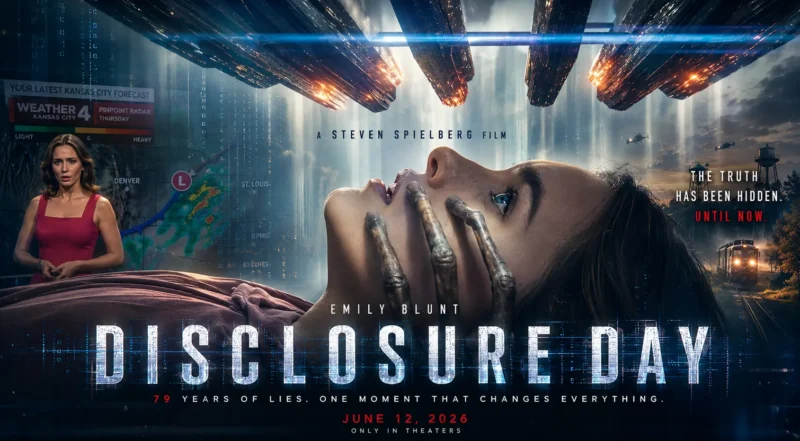
But there is another movie this trailer strongly resembles: Arrival. The scenes where Emily Blunt’s character suddenly loses control of language feel intentionally unsettling. A local weather broadcast collapses into fragmented sounds and clicking noises while everyone around her struggles to understand what is happening. It does not feel like possession. It feels closer to transformation or contact. That is where the film changes from conspiracy thriller into something stranger.
The movie’s visual tone too feels different from his earlier alien films. The lighting is colder. The pacing of the trailers is slower. Characters look exhausted rather than amazed. There is still wonder in the footage, but it feels restrained, almost cautious. That may differentiate Disclosure Day from Spielberg’s earlier work. The is still optimism there, but now it comes with anxiety.
Back when Close Encounters came out in 1977, alien stories often carried a sense of possibility. Today, audiences are much more conditioned toward distrust, conspiracies, and institutional collapse. Disclosure Day seems aware of that change. The government secrecy angle is not hidden at all. One character outright says humanity “cannot accept what we know.” Another warns that revealing the truth would “upend all established order.”
That build on Spielberg’s alien movies that have always reflected public fears of their time. What also stands out is how little the trailers actually show. There are almost no clear alien reveals. No giant attack sequences. No obvious action centerpiece. That could either work extremely well or frustrate viewers expecting a traditional science fiction blockbuster.
The casting too indicated more grounded approach. Emily Blunt tends to work best when balancing emotional realism with high-concept material, and she already proved that in A Quiet Place. Josh O’Connor brings a nervous intensity that fits the whistleblower angle. Colman Domingo and Colin Firth add a level of seriousness that suggests the film is aiming for tension rather than action.
One interesting detail from the second trailer is the inclusion of Spielberg discussing his own changing beliefs about extraterrestrial life. It is like framing Disclosure Day almost like the culmination of a lifelong fascination rather than just another science fiction movie.
There is a line in the trailer where a character says disclosure could remind humanity of its “capacity for empathy.” That is probably the clearest statement of what Spielberg is aiming for here. His best science fiction has never really been about aliens themselves. It is usually about how humans respond when confronted with something bigger than themselves.
That is why Disclosure Day does not feel like a random return to UFO stories. It feels like Spielberg returning to unfinished ideas.
The Sci-Fi film releases June 12, 2026, and if the trailers are accurate, this may end up being his most reflective science fiction movie since Artificial Intelligence. Not necessarily his biggest. Probably not his loudest. But maybe the one most connected to the themes he has revisited his entire career.
Some viewers will want answers. Spielberg has usually been more interested in wonder.
What to Watch After Disclosure Day
Arrival (2016)
A linguist is recruited to communicate with extraterrestrials after mysterious spacecraft appear around the world.
Close Encounters of the Third Kind (1977)
Spielberg’s classic about ordinary people becoming obsessed with mysterious signals connected to alien contact.
Signs (2002)
A quiet alien invasion thriller focused more on fear and faith than large-scale action.
The X-Files
FBI agents investigate paranormal cases involving conspiracies, alien encounters, and government secrecy.
Contact (1997)
A scientist discovers evidence of extraterrestrial intelligence and faces political and philosophical backlash.
Annihilation (2018)
A psychologically strange science fiction film about transformation, identity, and incomprehensible alien phenomena.