
David Robert Mitchell’s The End of Oak Street looks like a straightforward dinosaur survival movie for a while. A suburban neighborhood is ripped out of its normal surroundings by a mysterious cosmic event and dropped into a prehistoric world, leaving Denise Platt, played by Anne Hathaway, and her family trying to survive. Ewan McGregor plays her husband Greg, with Maisy Stella and Christian Convery as their children. The film opened in theaters on August 14, 2026. But the ending changes the movie’s rules. Take peek here as we give you The End of Oak Street Explained.
Spoilers ahead for The End of Oak Street.
The dinosaurs are important, obviously. However, the final act takes the focus from survival to time itself. And that is the biggest question surrounding The End of Oak Street: Did Denise actually travel back into her own past, or did she enter a different version of reality?
The movie never gives a clean scientific explanation. But that could be intentional. Mitchell has said he wanted the time-travel elements to remain ambiguous enough for viewers to make their own interpretations. And that makes the final scenes more interesting than a simple “they went back in time” explanation suggests.
The key moment comes after Greg’s apparent death. Greg confronts an allosaurus while trying to protect Denise, and the scene is played as a genuine sacrifice. For a movie that had spent so much time establishing the family’s strained relationship, his death initially feels like the point where the story finally commits to the consequences of its survival premise.
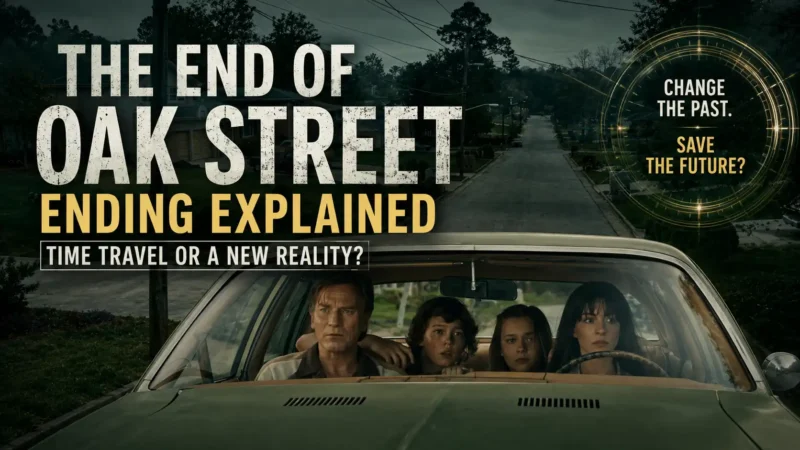
Except it doesn’t stay that way. The filmmakers originally intended Greg’s death to be permanent. According to Anne Hathaway and Ewan McGregor, the ending was changed around the beginning of production so that Greg could return. Hathaway was reportedly unsure about the change at first, but the new ending eventually won her over.
The family finds a way back to the moment before Oak Street disappeared. The return happens only minutes before the original event, which means Denise now has information that she didn’t have the first time around. She knows what is coming. She knows the neighborhood will disappear. And she knows Greg is going to die.
So Denise does what any desperate person would probably do in that situation. She tries to change it.
She warns people of what is about to happen, and the version of the event that follows is different. The prehistoric area is smaller, the circumstances have changed, and Greg survives. Starbucks also makes it back, which gives the ending an intentionally reassuring quality. The filmmakers even considered killing the dog before deciding to let him survive.
That looks like a classic time-travel reset. Denise has gone into the past, changed the events that caused the tragedy, and created a better outcome.
That interpretation works, but there is a problem.
If this is really Denise’s original timeline being rewritten, then the movie creates a paradox. The Denise who experienced the first version of events should no longer exist in exactly the same way. Greg’s death never happens. The family’s experience in the prehistoric world never happens in the same form. Yet Denise still remembers everything.
The movie doesn’t try very hard to solve that contradiction. And that is where the alternate-reality interpretation becomes more convincing.
Instead of imagining that Denise erased her original timeline, it is possible to read the ending as Denise entering a new branch of reality. The version of Greg she finds at the end is therefore not necessarily the exact same Greg who died earlier.
The distinction is small, but it changes the emotional meaning of the ending.
If the film operates according to branching timelines, then the original Denise and her children are still somewhere in that first reality. So are the consequences of everything that happened there.
This is not just a fan theory pulled out of nowhere. Viewers have noticed that the final scenes appear to contain dual versions of certain characters, including Jeanette, which has fueled discussion about whether the movie has created parallel versions of the family.
The film never confirms that interpretation. But it explains some of the strange details better than a simple reset does. No one has time travelled and so no one really knows what happens when a person travels back and forth. Do we change history? or do we create an alternative world in the same space?
There is another clue in the way the ending treats the prehistoric world.
The altered version of the event is not identical to what happened before. The affected area is different, and the circumstances surrounding the return have changed. That suggests the characters have not simply pressed rewind on a single timeline. Something has been altered at a more fundamental level.
The easiest comparison is Back to the Future, where changing the past creates a changed present. But The End of Oak Street is less interested in establishing strict rules. It is closer to a movie using time travel as an emotional device.
Denise gets another chance. That is really what the ending is giving her.
For most of the film, Denise is trapped in circumstances she cannot control. Her marriage is complicated, her family is suddenly in danger, and the world she understands disappears underneath her feet. The cosmic event takes away her normal life without asking permission.
The time-travel element eventually gives her something the dinosaurs could not take away: the ability to make a different choice.
Greg’s death too is not only a plot twist. It forces Denise to confront the possibility of losing her husband permanently. Bringing him back turns the ending into a second chance for the relationship as much as a second chance for the family.
There is a reasonable argument that the original death would have been more powerful. The film spends a lot of time establishing genuine danger, and Greg’s sacrifice carries weight precisely because the movie appears willing to let the consequences remain permanent.
Once the story introduces a way to undo that death, some of that tension disappears. At the same time, the revised ending fits the movie’s warmer side. Critics have noted that Mitchell mixes creature-feature thrills with family drama and nostalgia rather than making a purely bleak survival film.
So I don’t think the ending should be read as a failed attempt to explain time travel scientifically. It is better to interpret it as a deliberately loose sci-fi mechanism built around a simple emotional idea: what if you could go back to the worst moment of your life and stop it from happening?
The problem is that The End of Oak Street leaves us with an uncomfortable follow-up. What happened to the people in the timeline Denise left behind?
If the branching-reality interpretation is correct, there is potentially another Denise. Another Greg. Another set of children. And that version of the family may still be dealing with the prehistoric nightmare.
That makes the final family reunion look considerably less innocent. Denise gets Greg back, but the movie never proves that she saved everyone. It may have only saved her version of everyone.
And that is probably why the ending continues to invite debate. Mitchell gives viewers enough information to understand what Denise did, but not enough to establish exactly what happened to the discarded reality. The ambiguity is part of the design rather than something the movie accidentally forgot to explain.
So, is The End of Oak Street ending feel like time travel or is it creating a new reality?
The safest answer is that the movie leaves both possibilities open. The straightforward reading is that Denise travels back and changes the past. The more interesting reading is that she creates or enters an altered timeline where Greg survives.
And if the second interpretation is correct, the supposedly happy The End of Oak Street ending has a much darker edge. The Platt family gets home. Greg is alive. Starbuck survives. Oak Street is safe.
But somewhere in another version of the story, the family may still be trapped in the prehistoric world.
That is the question The End of Oak Street leaves behind, and honestly, it is more interesting than figuring out exactly how the cosmic phenomenon works.