
The biggest surprise about Enola Holmes 3 isn’t its mystery. It’s that the third movie of the trilogy doesn’t seem interested in recreating the formula that made the first two films such easy, enjoyable watches. Instead, director Philip Barantini and writer Jack Thorne push the series into more serious territory, giving Enola Holmes a case that feels less playful and far more personal.
That decision makes this the most divisive film in the trilogy. It also makes it more interesting.
Millie Bobby Brown returns with the same confidence that has carried the franchise since 2020. By now, Enola has grown beyond simply being Sherlock Holmes’ younger sister. She’s an established detective, and the film reflects that maturity. The opening quickly sets the stakes as Enola prepares to marry Tewkesbury, played once again by Louis Partridge, only for Sherlock’s disappearance to derail everything and pull her into another investigation.
Where Enola Holmes 3 changes most is its tone? The earlier Netflix films balanced detective work with humor, adventure, and frequent fourth-wall breaks. Those elements haven’t disappeared entirely, but they’re no longer the main attraction. Instead, the story spends more time exploring family, responsibility, and Britain’s colonial influence in Malta. It’s a more ambitious approach, even if it occasionally slows the pace.
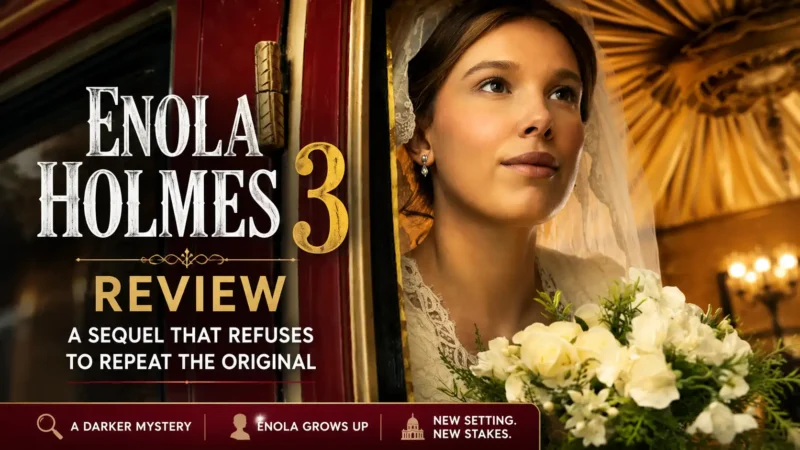
This approach might split audiences. If you loved the earlier film because they felt like comforting mystery adventures with plenty of charm, this sequel may seem heavier than expected. The jokes are less frequent, the mystery unfolds more deliberately, and the emotional moments carry greater weight. But if you’ve wanted the series to grow alongside its lead character, the changes feel earned.
Enola Holmes 3 Review
Millie Bobby Brown remains the franchise’s biggest strength. She has settled well into Enola’s personality, balancing intelligence, determination, and vulnerability. The confidence she displayed in the first film has evolved into something quieter and more assured. She no longer needs to prove herself to everyone around her, and Brown’s performance reflects that in her performance.
Henry Cavill also benefits from the story’s more mature direction. Sherlock has fewer scenes than some viewers might expect. Instead of serving as the brilliant detective who inevitably steals the spotlight, he becomes an emotional counterbalance to Enola here. Their relationship has always been one of the series’ highlights, and this film deepens it without overshadowing Enola’s own journey.
Louis Partridge continues to bring warmth to Tewkesbury. Rather than turning the film into a romance, his presence reminds viewers how much Enola has changed since the first movie. Their relationship feels more natural because it has developed across three films instead of being rushed into the spotlight.
The mystery too becomes more complicated to evaluate. There are a few satisfying twists, some enjoyable detective work, and enough clues to keep the investigation engaging. But compared to the first two films, the central case isn’t quite as inventive. Experienced mystery fans may see several revelations coming before Enola does.
Some early reviews focus on this as the movie’s biggest weakness. That could be a let down to hard core mystery fans. But Enola Holmes 3 doesn’t appear to be trying to build the trilogy’s smartest puzzle. TIt is more interested in exploring Enola’s transition into adulthood rather than an elaborate detective challenge.
Instead of asking whether Enola can solve another mystery, it asks what happens after she has already proven herself. The story becomes less about earning respect and more about balancing independence, family, and personal happiness.
Philip Barantini’s direction deserves credit for supporting that change. Coming off projects known for their intensity, he brings a more restrained style than Harry Bradbeer. The cinematography is moodier, the pacing is steadier, and several scenes are allowed to develop instead of rushing toward the next joke or action sequence. The visual style also gives the sequel its own identity instead of making it feel like a copy of its predecessors.
And that is one reason why Enola Holmes 3 feels different from other modern mystery franchises like Knives Out. Those films thrive on intricate plotting and constant surprises. Here, the emotional journey matters just as much as solving the case.
One problem is that the franchise built its audience on a lighter, more accessible style. The first two films felt like comfort viewing, combining mystery with humor and adventure in a way that appealed to both younger audiences and adults. This sequel deliberately steps away from that formula, and not everyone will follow it.
Enola Holmes 3 takes the risk of changing its tone, even if that means losing some of the effortless charm that made the originals so widely loved.
Bottomline. It’s not the strongest mystery in the trilogy, and it probably isn’t the most entertaining either. But it may be the most confident. Rather than chasing the success of the original film, it accepts that Enola has grown up, and the stories around her have to grow as well.