
When Prime Video announced Every Year After, many viewers immediately saw another summer romance arriving on streaming. But the challenge facing this series is very different from launching a typical young adult drama. It is adapting a novel that built an unusually passionate audience long before cameras started rolling.
Carley Fortune’s Every Summer After spent 16 weeks on the New York Times Bestseller list and sold more than a million copies. The novel also found a second life on BookTok, where readers turned Percy and Sam’s relationship into one of the platform’s most talked-about romance recommendations. The hashtag surrounding the book generated millions of views, helping introduce the story to readers who may never have discovered it through traditional publishing channels.
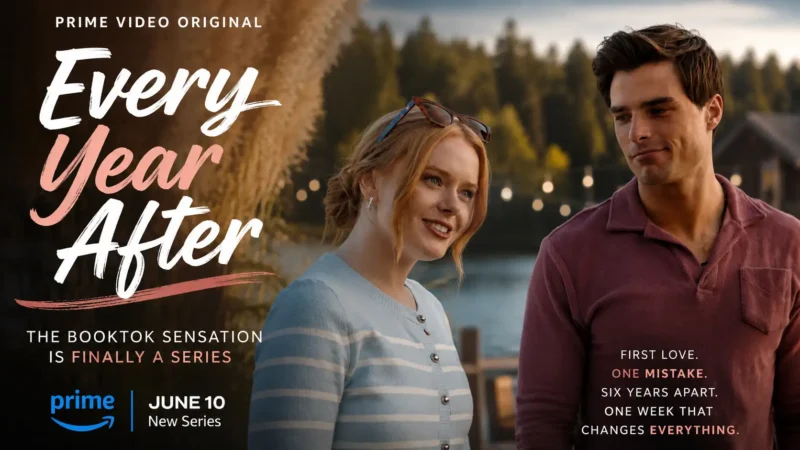
That popularity creates both excitement and pressure for Every Year After, which premieres June 10 on Prime Video with all eight episodes available at launch. The series stars Sadie Soverall as Percy Fraser and Matt Cornett as Sam Florek, the childhood friends whose relationship unfolds across years of summers spent in Barry’s Bay, a lakeside town that becomes as important to the story as the characters themselves.
The reason BookTok embraced Every Summer After was never just the romance. There are countless friends-to-lovers stories available. What readers connected with was the sense of longing that runs through every chapter.
The novel spends much of its time looking backward. Percy is carrying the weight of a mistake that changed everything. Readers know something went wrong long before they know what it was. That creates a quiet tension throughout the story. The romance matters, but so does the question of whether someone can ever truly move beyond a decision they regret.
That emotional foundation appears to be captured in the trailer. Instead of focusing exclusively on first love, the footage emphasizes what happens after love falls apart. Percy returns to Barry’s Bay after years away and immediately finds herself confronting memories she has tried to avoid. Sam has moved on, at least on the surface. There is a girlfriend. There are warnings from friends. There are people who clearly believe reopening old wounds will only make things worse.
Shows like The Summer I Turned Pretty often focus on the excitement and uncertainty of young love. Every Year After appears more interested in what happens when time passes and emotional baggage follows people into adulthood. Even though the story includes teenage years, the emotional conflict feels more mature than many recent YA adaptations.
The casting of Every Year After also suggests the series understands what readers valued in the book. Sadie Soverall brings a grounded quality that fits Percy’s internal struggle. Matt Cornett has already demonstrated strong emotional range in previous projects, which will be important because Sam’s appeal was never based on grand gestures. Readers loved him because he felt dependable, patient, and deeply connected to Percy long before romance entered the picture.
Another reason the novel became such a BookTok success is that it taps into a very specific kind of nostalgia. Barry’s Bay is filled with lakes, docks, summer traditions, and friendships that seem permanent until life changes them. Readers often described wanting to live inside that setting. The atmosphere became almost as memorable as the plot itself. If the series can recreate that feeling, it may win over viewers who have never read a page of Fortune’s novel.
BookTok audiences tend to be protective of the stories they champion. They notice missing scenes, altered character dynamics, and changes to emotional moments. Some viewers will inevitably compare every episode to the novel. But successful adaptations rarely work because they recreate a book word for word. They succeed when they preserve the emotional experience that made readers care in the first place.
Every Year After trailer suggests Prime Video understands that Percy and Sam’s story is built on yearning, regret, friendship, and second chances rather than dramatic twists. If the series can capture those feelings, it has a chance to connect with both longtime readers and newcomers looking for a romance that feels a little more reflective than the average summer love story.
BookTok helped turn Every Summer After into a publishing phenomenon. Now the question is whether Every Year After can create that same emotional connection on screen. Based on what we’ve seen so far, the ingredients are certainly there.