
Obsession (2026) starts with a setup that feels almost predictable. A guy likes a girl. He cannot say it out loud so he finds something that promises an easy shortcut. That should tell you where this is going. But the film doesn’t follow the expected version of that idea too long.
Directed by Curry Barker and set for release on May 15, 2026, the film follows Bear, played by Michael Johnston, who uses a novelty item called the “One Wish Willow” to make Nikki, played by Inde Navarrette, fall in love with him. It works! And that is where the film takes a turn.
Most “wish gone wrong” stories rely on sinister rules. The price you must pay for the wish. Obsession avoids all of that. The wish does not explode into chaos right away. It waits, lurks and keeps you waiting too in quiet tension.
Nikki does not just fall in love, she becomes fixated. Her behavior changes in ways that are hard to explain but easy to notice. There is no clear supernatural display here. No dramatic transformation. Just a steady tightening of her attention toward Bear, and a growing sense that something is off.
The horror here is not in what the wish does physically. It is in how it builds and distorts its target’s behavior. The film treats the outcome almost like a psychological condition rather than a curse.
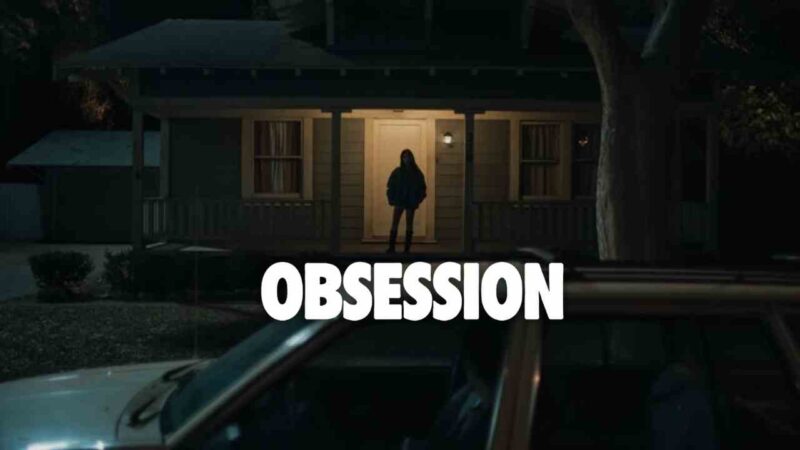
The One Wish Willow itself is does not come across as some grand, mystical object. It looks like something you could buy in a random shop. That simplicity and commonness lowers your guard. It makes Bear’s decision feel impulsive instead of dangerous. He is sure it will work, but he still makes the wish anyway.
Obsession Movie – What to Expect
And if you look closely it is the wording of that wish which quietly sets up its entire conflict. Bear does not wish for Nikki to be happy. He wishes for her to love him more than anyone else in the world. And that is what he gets.
This is where Obsession leans fully into psychological horror. The wish is not twisted by an external force. It is already flawed from the start. The outcome is just a direct extension of what Bear asked for.
As Nikki’s behavior becomes more intense, the film does not rush into chaos. It makes you feel the discomfort. Scenes are allowed to stretch. Conversations linger. You sit in those still moments that feel slightly wrong before they become openly disturbing. That pacing choice lines up with Barker’s approach to long takes and minimal cuts, which keeps everything grounded in Bear’s perspective.
There is also no easy separation between victim and cause. Bear is not dealing with something that happened to him. He created it. And even when he starts to see the consequences, part of him still wants the fantasy to hold together.
That tension is what carries the film. It is not about stopping a curse. It is about recognizing that the problem was built into the wish itself.
Obsession ends up feeling less like a supernatural story and more like a character study that happens to use a supernatural trigger. The horror comes from watching a normal desire pushed just far enough to reveal what was already underneath it.
It takes a familiar idea and removes the usual distance. There is no elaborate mythology to hide behind. Just a simple decision, a poorly worded wish, and the slow realization that getting exactly what you want can be the worst outcome.